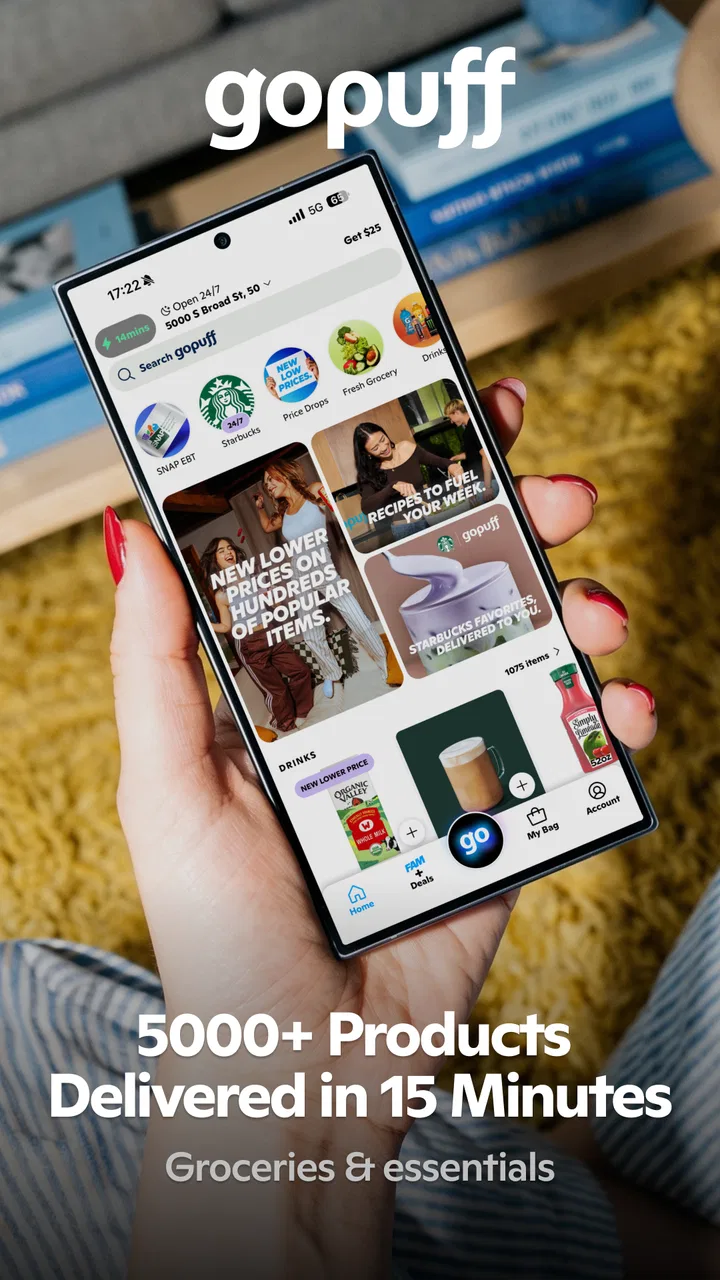
Gopuff - Grocery Delivery
- 4.6
- Rating
- 5.00M
- Installs
- Free
- Price

 Analysis by App-foxy
When I need a few groceries or everyday items without turning a small errand into a full shopping trip, Gopuff is the kind of app I consider first. I reviewed it as a food and drink app from Gopuff, and its appeal is easy to understand: it brings food, household basics, and other essentials into one ordering experience, with availability that can suit late-night situations. The app is free to install, carries a Mature 17+ age rating, and has built a large audience, with more than five million installs and an average score of 4.6 from roughly ninety thousand ratings.
That popularity does not make it perfect for everyone. My experience is that its usefulness depends heavily on what is available in your area, how quickly you need the order, and whether browsing a delivery catalog feels easier than visiting a shop. The strongest reason to try it is convenience, especially when leaving home is difficult or inconvenient. The strongest reason to hesitate is that delivery apps can make simple purchases feel less predictable than walking into a supermarket and choosing an alternative yourself.
How Gopuff feels to use in everyday situations
I find Gopuff easiest to judge by the small problem it solves: getting a handful of essentials without making a separate trip. In this section, I’ll focus on how that convenience changes the feel of an ordinary day, including the moments when a quick delivery is genuinely helpful and the times when I’d rather use a different way to shop.
You May Also Like

 Pandora - Music & Podcasts
Pandora’s Music Is Easy to Start, but Harder to Recover
Pandora’s strength is its low-effort path from a seed to a station. Its weak spot is how much confidence it asks you to place in connection, setup, and quiet recovery.

 8 Ball Pool
 Is Built on Rivalries, Rematches, and Routine
A close look at the rivalries, rematches, shared routines, and unanswered safety questions that turn a quick pool match into a persistent mobile community.

 Samsung Music
’s Quiet Strength Is Playing What You Already Own
Its reach comes less from spectacle than from dependable access to a personal library. That simplicity is both the app’s strongest retention engine and its ceiling.

 AccuWeather: Weather Radar
AccuWeather Review: A Quick, Clear Forecast for Everyday Decisions
For everyday plans, the best forecast is the one you can understand quickly. AccuWeather makes rain timing, radar, and local conditions easy to act on, with a few trade-offs.

 Hill Climb Racing
Why Hill Climb Racing Still Turns Crashes Into One More Run
A tiny car, a bumpy hill and one more upgrade: Hill Climb Racing keeps resurfacing because its simple chaos makes every near-miss feel personal.

 AliExpress - Shopping App
AliExpress Makes Global Shopping Feel Personal, but Shoppers Bear the Risk
AliExpress turns a global marketplace into a pocket-sized discovery engine. Its reach is useful, its shopping loop compelling, and its trade-offs easy to miss.
More From Our News Desk
View All News


Readability and navigation during a quick order
Gopuff works best when I approach it with a clear purpose. If I already know that I need drinks, snacks, breakfast items, cleaning supplies, or a few emergency household basics, the app can turn that short list into a focused search rather than a broad shopping trip. I find this more comfortable than wandering through a large supermarket app where the catalog is built around a full weekly shop.
The central challenge is that a delivery catalog can still become visually busy. Food, beverages, household items, and impulse purchases sit close together, so a person who is tired, distracted, or working with a limited attention span may need to slow down before checking out. I recommend searching for one item at a time and reviewing the basket carefully afterward. That simple habit reduces the chance of adding a similarly named product or overlooking a substitution in the rush.
For readers who depend on larger text, stronger contrast, screen magnification, or a screen reader, the practical experience will depend partly on how the app behaves with the accessibility settings on the phone. I would not treat the store rating as proof that every part of the interface works equally well for every user. Instead, I would begin with a small order and see whether product names, quantities, basket controls, and checkout messages are easy to identify on your device.
One useful approach is to separate browsing from decision-making. I first collect the items I recognize, then pause before placing the order to check quantity, size, and total cost. This is especially important for products that appear in several formats. The fastest possible checkout is not always the clearest checkout, and a thirty-second review can be more valuable than saving a few taps.
The app is also more approachable for people who prefer predictable routines when they use it as a repeat-order tool in their own way. Keeping a short personal list of regular items, or remembering the search terms that worked previously, can reduce the mental effort of starting from the home screen. I would not assume that every item will always be available, so I treat familiar searches as a shortcut, not a guarantee.
Motor and sensory considerations
For someone with limited mobility, chronic pain, fatigue, or difficulty carrying bags, delivery can remove several demanding steps from an ordinary purchase. There is no need to travel to a shop, walk through multiple aisles, stand in a checkout line, or carry groceries home. That makes Gopuff potentially valuable even when the order itself is small.
At the same time, ordering still requires a series of precise actions: selecting products, adjusting quantities, entering or confirming delivery details, and completing payment. Users with tremors, reduced dexterity, or difficulty with small touch targets may find rapid browsing uncomfortable. I recommend using the phone’s built-in touch accommodations, voice control, or an external keyboard where those tools already form part of your usual setup. The app should be judged alongside the device settings that make mobile shopping manageable for you.
Sensory overload is another consideration. A catalog containing snacks, drinks, meals, and household products can encourage constant scrolling and comparison. I find the experience calmer when I search directly instead of exploring every recommendation. If bright screens, animation, promotional panels, or dense layouts are tiring, a short, planned order is likely to be more comfortable than open-ended browsing.
People with food allergies or strict dietary requirements should be particularly careful. I would read the product information available in the app, but I would not rely on a delivery catalog as the only source for a serious allergy decision. Packaging, ingredients, and manufacturing details can matter, and the item that arrives may need to be checked before it is opened. For ordinary preferences, the app can be convenient; for medically important restrictions, the extra verification step is essential.
There is also a sensory advantage for some users: ordering from home can avoid crowded stores, loud checkout areas, strong smells, and unpredictable queues. That can make the service a better fit for people who find physical retail environments overwhelming. However, delivery does not remove every uncertainty. Waiting for an order, monitoring notifications, and handling an unexpected replacement can create a different kind of stress.
Situational access when leaving home is not practical
Gopuff makes the most sense in situations where the need is immediate but not worth a full trip. Imagine realizing late in the evening that you have run out of breakfast items, pet-related basics, drinks, or a household product needed the next morning. In that moment, an app that stays useful outside normal shopping hours can be more practical than waiting for the next day.
I also see value for someone recovering from an illness or injury, a caregiver who cannot leave a sleeping child, a remote worker between meetings, or a person whose transport has been canceled. The order does not need to be a large grocery haul to be worthwhile. Its role is closer to a rapid top-up: fill the gap, avoid the trip, and get back to the day.
That convenience should be balanced against the usual supermarket alternative. A physical store gives me more control over freshness, size, substitutions, and product comparison. A supermarket’s own delivery service may be better for a planned weekly shop because it can support a larger, more structured basket. A restaurant delivery app may be the better choice when I want a prepared meal rather than ingredients or everyday essentials. Gopuff sits between these options, aimed at the small, mixed order that is awkward to handle elsewhere.
For people who cannot easily answer the door, situational planning matters. I would place an order when I can monitor the delivery and make sure the drop-off environment is safe and accessible. If reaching the entrance involves stairs, a locked building, a long corridor, or a difficult handoff, the convenience may be reduced. The app can simplify shopping, but it cannot redesign the building where the order arrives.
Late availability is useful, but it should not be confused with unlimited availability. The item I need may be unavailable in my local area, or the selection may be narrower than a nearby supermarket. I use Gopuff for flexibility rather than for a promise that every emergency purchase will be covered. A backup plan is sensible when the item is essential.
Small workflows that make the experience more inclusive
One of my most useful habits is building the basket in two passes. In the first pass, I search only for the essentials. In the second, I check sizes, quantities, and the final basket before paying. This helps people who need more time to process information and also protects against the common mistake of choosing the first visually similar result.
Another practical tip is to order before the situation becomes urgent. If I know that a busy evening is coming, placing the order while I can concentrate is easier than trying to shop when I am already exhausted. This is not as exciting as last-minute delivery, but it makes the service more accessible for users who struggle with time pressure, fatigue, or decision overload.
I would also keep the order modest when testing the app. A small basket reveals whether the product search, checkout flow, delivery instructions, and handoff suit your needs without creating a large financial or practical problem. Once that routine feels reliable, the app becomes easier to use for more demanding situations.
For users who share shopping responsibilities, clarity is important. Before ordering, I would confirm the exact item and quantity with the person who needs it, especially when several versions of a product look alike. This is helpful for caregivers and for anyone shopping on behalf of a person with visual, cognitive, or communication-related needs. A quick confirmation can prevent an inconvenient delivery that is technically correct but unusable.
People who rely on assistive technology should test the most important path rather than judging the entire catalog at once: open the app, find one familiar item, add it, review the basket, and reach checkout. If that sequence is comfortable, the service may be workable even if browsing less familiar categories is harder. If the basic path is difficult, the convenience advantage may not justify the extra effort.
Remaining barriers and honest trade-offs
The first barrier is dependence on local selection. Gopuff can only be useful when the products you need are offered for your delivery area. This matters more for people with strict dietary needs, specific medical routines, or household products that cannot be replaced easily. A supermarket trip, another delivery service, or a trusted local shop may provide better control in those cases.
The second barrier is the difference between speed and certainty. Fast delivery is attractive when I need something soon, but a quick order still requires me to check the basket and be prepared for the possibility that an item is not available as expected. If I need a precise brand, exact package size, or guaranteed ingredient list, I prefer a channel that gives me stronger control over those details.
Cost also deserves attention, even though the app itself is free. A free download does not automatically make every order the cheapest way to shop. Delivery-related charges, product pricing, and the temptation to add unplanned items can change the value of a small order. I compare the convenience with the cost of traveling to a nearby store, but I also compare the basket with a supermarket order before deciding that speed is worth it.
The Mature 17+ rating is another reason families should think about who will use the account and how orders are managed. I would not hand the app to a younger user without considering the nature of the products available and the responsibility involved in placing deliveries. For adults, that rating is a reminder to use the service thoughtfully rather than treating it like a children’s snack catalog.
There is a human limitation too: delivery cannot replace the reassurance of choosing products personally. Freshness, packaging condition, and substitutions can matter, particularly to people with sensory sensitivities or dietary restrictions. If a wrong item would create a serious problem, I would choose a shopping method that offers more direct inspection or arrange help from someone who can check the products.
The app has been available since November 2013 and is currently at version 12.20.0, with support beginning at Android 8.0. Those details make it accessible to people using a range of older Android devices, although the actual comfort of the experience will still depend on screen size, system settings, and the phone’s performance. I would update the app and the operating system where possible, especially if navigation or notifications behave inconsistently.
Who should use it, and who should choose something else?
I would recommend Gopuff to adults who value avoiding a store trip and usually need a small mix of food and everyday essentials. It is particularly suitable for late-night top-ups, busy workdays, temporary mobility limitations, and situations where a short delivery is more realistic than a full grocery run. Its broad purpose is more useful than a restaurant-only service when the missing item is a household basic rather than dinner.
I would be more cautious for a person who needs a large weekly shop, precise fresh-produce selection, specialist dietary products, or the lowest possible total cost. In those cases, a supermarket’s own service may provide a better catalog and more control. Someone who dislikes waiting at home or cannot manage delivery handoffs may also prefer a local shop with pickup or assistance from another person.
The app is free, and its strong average rating and audience size suggest that many people find the basic experience worthwhile. I still see those figures as a starting point, not a substitute for testing the service in your own neighborhood. Delivery coverage, local inventory, and the accessibility of the checkout flow matter more to an individual user than a general score.
My inclusive verdict after using Gopuff
Gopuff is at its best when convenience removes a real barrier: distance, fatigue, late hours, crowds, or the need to carry a few essentials. I like it as a focused top-up service rather than as a complete replacement for every kind of grocery shopping. The ability to order mixed everyday items from home can make ordinary life noticeably easier, especially when energy and time are limited.
Its inclusive value is practical rather than magical. It can reduce the physical and sensory demands of visiting a store, but users still need a clear way to navigate products, review the order, manage delivery access, and verify important items. I would start with a small basket, use device accessibility settings that already help me, and keep a backup option for products that must be exact.
After reviewing the app, I think Gopuff is most useful when speed, reduced travel, and a manageable small order matter more than maximum product control. It is a sensible choice for many adults, but not the right answer for every dietary, mobility, sensory, or budget situation. If you understand that trade-off, the app can become a genuinely helpful part of your routine instead of another source of rushed decisions.
FAQs for Gopuff - Grocery Delivery
01What is Gopuff - Grocery Delivery, and what can I order through it?
Gopuff is an on-demand delivery app designed for everyday essentials rather than only restaurant meals. Depending on your location, you can browse groceries, snacks, drinks, household supplies, personal-care products, over-the-counter items, baby necessities, pet supplies, and other convenience goods. The available catalog, brands, delivery times, and product categories vary by city, local inventory, and applicable regulations.
02How much does Gopuff delivery cost, and are there additional fees?
The total price can include the item cost, a delivery or service fee, taxes, and possible small-order, membership, or regulatory charges. Fees and minimum order requirements may differ according to your location, order size, delivery speed, and whether you subscribe to a Gopuff membership plan. Before confirming an order, review the checkout screen carefully because the final amount is the most reliable summary of all applicable charges.
03How fast does Gopuff deliver, and can I track my order?
Gopuff focuses on quick local delivery, with estimated arrival windows shown in the app before you place an order. Actual timing depends on inventory, distance, traffic, weather, demand, and courier availability. After checkout, the app normally provides order-status updates and tracking information when available. Delivery estimates are not guaranteed, so users with time-sensitive needs should check the latest status and instructions in the app.
04Can I use Gopuff to order alcohol, tobacco, or age-restricted products?
In some locations, Gopuff offers alcohol, tobacco, nicotine products, or other age-restricted items, but availability depends on local laws, licensing, store inventory, and the delivery address. Customers may need to meet the legal age requirement and present a valid government-issued photo ID at delivery. The recipient must also satisfy any local verification rules; otherwise, the restricted items may be refused or removed from the order.
05What should I do if an item is missing, damaged, unavailable, or incorrect?
If your order arrives with a missing, damaged, expired, substituted, or incorrect product, open the order details in the Gopuff app and use the available help or support option as soon as possible. Describe the problem accurately and include photos when requested. Resolution may involve a refund, credit, replacement, or another remedy depending on the circumstances. Keep the packaging and receipt information until the issue is resolved.
Pros
- Fast delivery windows for groceries
- snacks
- drinks
- and household essentials.
- Convenient late-night ordering in many supported service areas.
- Easy browsing with useful categories and search filters.
- Real-time order updates help track preparation and delivery progress.
- Offers
- bundles
- and membership perks can reduce repeat-order costs.
Cons
- Availability and delivery times vary significantly by location.
- Small orders may become expensive after fees
- taxes
- and service charges.
- Product selection can be narrower than a full-size supermarket.
- Some items may be unavailable after you place an order.
- Age-restricted purchases require identity and age verification.

Gopuff - Grocery Delivery
Gallery